 +91 1664-243891/92/94
 info@hindustangum.com


.png)
.png)
Drip Fertigation vs Soil Application: Which Fertilizer Method Improves Efficiency More?
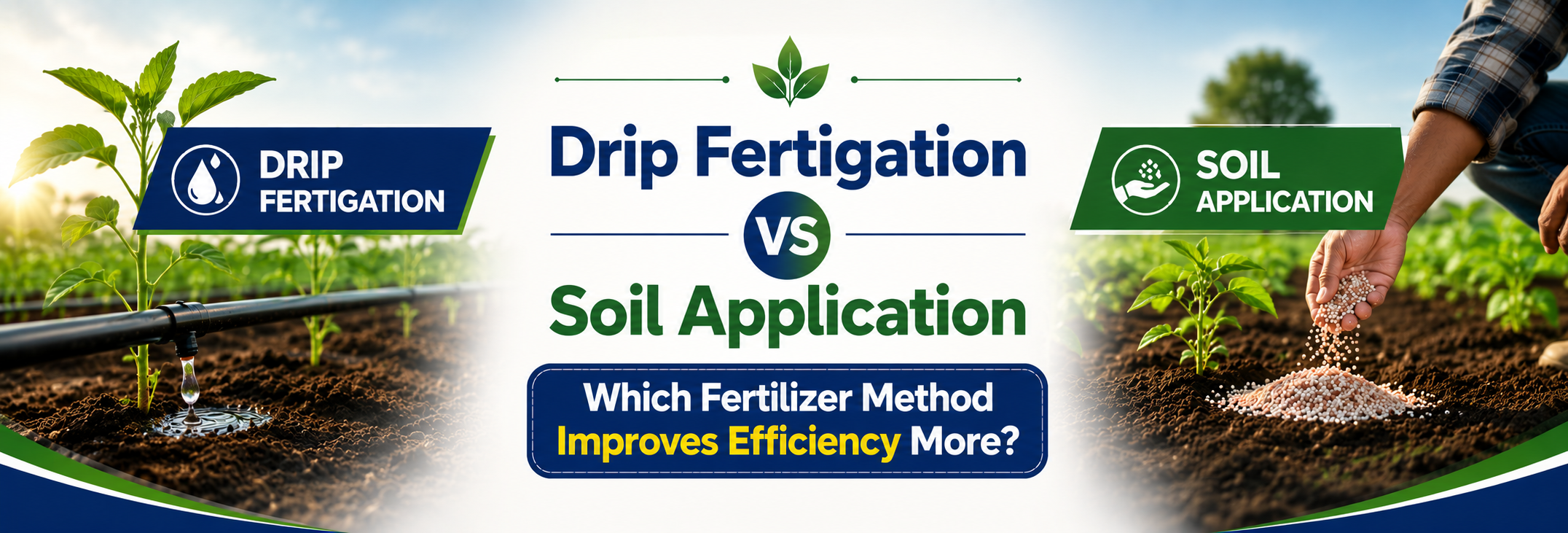
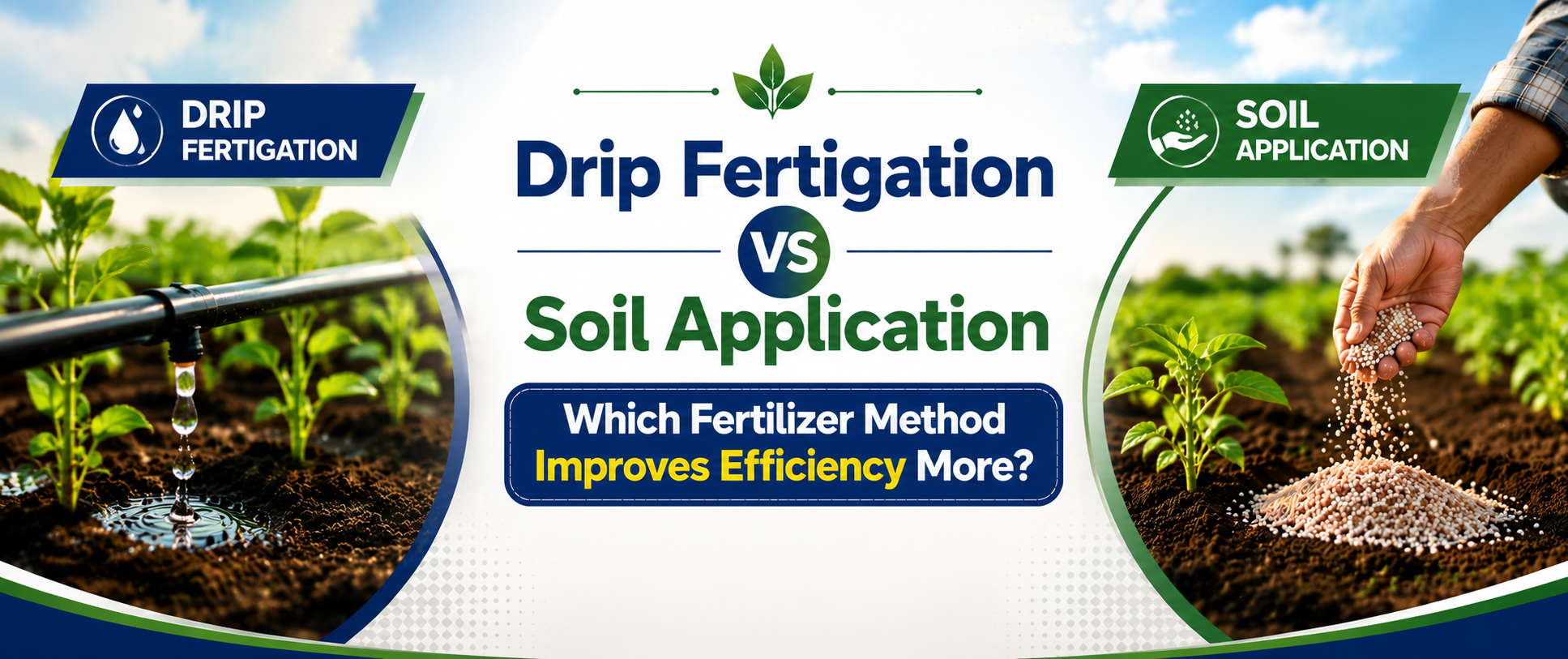
Drip Fertigation vs Soil Application: Which Fertilizer Method Improves Efficiency More?
Modern commercial farming is locked in a continuous race against rising input costs and fluctuating environmental conditions. In this competitive landscape, the key to profitability isn’t simply the volume of inputs used, but how effectively crops absorb them. Traditional broadcasting and soil application methods have served agriculture for generations. However, as global agriculture shifts toward precision cultivation, optimizing Nutrient Use Efficiency (NUE) has become a top priority for forward-thinking agribusinesses and farmers alike.
When evaluating drip fertigation vs soil application, growers are comparing two entirely different nutrient delivery philosophies. Soil application relies heavily on environmental luck, hoping that rainfall or manual irrigation will dissolve and distribute the nutrients uniformly to plant roots. In contrast, a fertigation system utilizes precision farming principles to inject water-soluble fertilizer directly into the irrigation infrastructure.
This comprehensive guide analyzes the operational mechanics, agronomic impacts, and structural return on investment (ROI) of both fertilizer application methods to determine which system truly maximizes efficiency for your enterprise.
Understanding the Core Methodologies
To accurately assess fertigation vs soil fertilization, it is vital to examine how each method handles nutrient delivery at the root zone level.
Traditional Soil Application
Traditional soil application involves broadcasting granular fertilizers across the field surface or placing them in targeted bands near seeds during sowing. While mechanically straightforward, this method places a heavy buffer between the fertilizer and the plant's vascular network. The solid nutrients must wait for sufficient soil moisture to dissolve, leaving them highly exposed to the atmosphere and surrounding soil chemistry for extended periods.
Advanced Drip Fertigation
Drip fertigation integrates irrigation and nutrition into a single, automated operational step. By feeding highly soluble, liquid-grade nutrients directly into a customized drip irrigation setup, the system bypasses atmospheric barriers entirely. Nutrients are delivered uniformly in low, continuous doses directly within the active root zone (the wetted soil profile), precisely matching the real-time metabolic demands of the crop.
Nutrient Use Efficiency (NUE): The Data-Driven Comparison
The primary metric used to evaluate any drip irrigation fertilizer method is Nutrient Use Efficiency (NUE)—the exact percentage of applied fertilizer that is successfully absorbed by the plant rather than lost to the environment.
Why Soil Nutrient Absorption Suffers in Traditional Systems
When solid granules are broadcast onto dry or unevenly moist land, significant nutrient degradation occurs via three primary pathways:
Volatilization: Nitrogen sources like urea rapidly convert into ammonia gas when left exposed on warm, moist soil surfaces, dissipating into the atmosphere.
Leaching: Heavy, unpredictable rainfall washes highly mobile nutrients, such as nitrates, deep past the shallow root zones and straight into groundwater tables where crops cannot reach them.
Soil Fixation: Vital macro-elements like phosphorus bind tightly to soil minerals (like iron, aluminium, or calcium, depending on pH levels), rendering them chemically insoluble and unavailable for root uptake.
How Drip Fertigation Solves the Efficiency Problem
Does drip fertigation increase fertilizer efficiency? The empirical data confirms it does. Because nutrients are fully dissolved in water before application, they are immediately bioavailable for soil nutrient absorption.
By applying micro-doses consistently throughout the production cycle rather than one or two massive basal dumps, you eliminate the volatile peaks and valleys of nutrient availability. The soil matrix remains steadily optimized, ensuring that roots are never chemically burned by high salt concentrations or starved by prolonged nutrient leaching.
Core Operational Advantages of Drip Fertigation
Choosing a modern fertigation system over manual field broadcasting yields a wide range of operational advantages that directly optimize your farm management workflows.
Precision Placement and Micro-Dosing
Traditional field application uniformly covers the entire surface area, effectively preventing unwanted weeds in the inter-row spaces. Fertigation completely shifts this dynamic by confining the wet nutrient zone strictly to the crop's active root architecture. This targeted concentration ensures that every rupee spent on premium inputs goes directly toward crop development rather than sustaining competitive weed populations.
Substantial Labor and Energy Savings
Manually broadcasting fertilizer demands hundreds of hours of intensive labour and tractor usage, which translates to high fuel and mechanical maintenance costs. Fertigation automates this entire process. A farm manager can comfortably adjust nutrient formulations right from a centralized control valve station or smartphone application, eliminating field passes and drastically reducing manual labour overhead.
Perfect Synchronization with Crop Phenology
A crop’s nutrient requirements change drastically as it transitions from initial vegetative growth to flowering, fruit set, and eventual maturation. Solid soil applications lack the agility needed to match these rapid metabolic shifts. With drip fertigation, agronomy teams can adjust the exact N-P-K ratios on a weekly or even daily basis, providing tailored nutrition that perfectly aligns with the plant’s biological growth stages.
Overcoming Key Operational Barriers in Fertigation
While drip fertigation offers unmatched efficiency, transitioning to this precision model requires careful management of specific operational challenges.
Capital Infrastructure Costs: Setting up high-grade drip lines, advanced filtration units, backflow preventers, and specialized injection pumps requires a higher upfront financial investment than purchasing a standard mechanical broadcast spreader.
Emitter Clogging Risks: Because drip emitters have highly precise, microscopic openings, using low-quality or poorly dissolved fertilizers can result in chemical precipitation and severe line blockages. This issue can easily compromise your water distribution uniformity.
The Need for Premium Water-Soluble Fertilizer: Traditional granular fertilizers are poorly suited for irrigation lines due to insoluble fillers and anti-caking agents. Successful fertigation requires highly refined, fully water-soluble nutrients that dissolve completely without leaving a physical residue.
Strategic Optimization: The Fertilizer Efficiency Enhancer
Transitioning your farm fully to drip fertigation is an excellent first step toward building a highly efficient operation. However, managing irrigation water movement within varying soil types can still present hidden challenges. In sandy or porous soils, water and dissolved nutrients can still migrate downward past the root zone too quickly. Conversely, in dense clay soils, water can pool and limit oxygen availability to the roots.
To solve this problem and maximize your infrastructure investment, integrating a targeted Fertilizer Efficiency Enhancer into your field management protocol is highly recommended. Implementing high-performance soil conditioners like Hindustan Gum’s Ankurayam helps bridge the gap between water delivery and optimal plant uptake.
When applied directly to the root zone during field preparation, this advanced, biodegradable super-absorbent polymer acts as a smart, physical nutrient reservoir. It absorbs up to hundreds of times its weight in water and dissolved nutrients, turning them into an eco-friendly gel matrix right where the roots live.
As a result, even during heavy irrigation cycles, your valuable water-soluble fertilizers are locked safely in place, completely protected from rapid downward leaching. During drier intervals, the gel gradually releases moisture and vital macronutrients back to the plant at a highly stable, uniform rate. By incorporating this simple soil-conditioning step into your setup, you significantly extend your fertilizer's holding time, cut down on overall input waste, and ensure a highly predictable return on investment for your irrigation system.
Conclusion: Which Method Wins?
When deciding which is better, drip fertigation or soil application, the operational and financial choice is clear. While traditional soil application remains a functional, low-tech option for broad-acre, rain-fed crops with minimal margins, it simply cannot compete with the sheer precision of localized root-zone management.
For modern commercial growers targeting maximum crop quality and higher market yields, drip fertigation is undeniably the best fertilizer application method for crops. By delivering perfectly balanced, fully dissolved nutrients directly to the plant's root system, fertigation effectively doubles your Nutrient Use Efficiency, dramatically reduces field labour costs, and protects your surrounding environment from chemical runoff.
By pairing an automated fertigation network with advanced soil conditioning solutions like Hindustan Gum Ankurayam, you create a highly optimized growing environment built to thrive through changing market demands and seasons.
Frequently Asked Questions (FAQs)
Q1. Can any standard commercial fertilizer be used in a drip fertigation system?
No. Standard granular fertilizers contain chemical fillers and hydrophobic anti-caking coatings that do not dissolve cleanly in water. Using them will quickly clog your drip emitters. Fertigation requires specialized, 100% water soluble fertilizer designed to dissolve instantly without leaving behind a physical sediment or scum.
Q2. Does shifting to drip fertigation actually lower overall fertilizer consumption?
Yes, absolutely. Because drip fertigation increases your overall Nutrient Use Efficiency (NUE) from a low 30–40% up to an impressive 80–95%, you can achieve equal or superior crop yields while applying up to 25–40% less raw fertilizer overall. This reduction drastically cuts down on your seasonal input costs.
Q3. How frequently should I inject fertilizers through my drip system?
For optimal results, high-frequency, low-dose applications are best. Depending on your specific soil texture and crop type, injecting nutrients every 3 to 7 days is generally far more effective than applying a massive monthly dose. This consistent schedule keeps root-zone nutrient levels highly stable and uniform.
Q4. What are the main signs that a fertigation system is clogging?
The earliest indicator of system clogging is an unexpected drop in water pressure uniformity across your drip lines, alongside uneven crop growth near the ends of your fields. To prevent these blockages, always use high-quality nutrients, flush your irrigation lines with clean water after every injection cycle, and maintain a robust filtration system.
Q5. How does a soil conditioner like Ankurayam improve fertigation performance?
While drip lines deliver nutrients perfectly, light soils can still allow water to leach away quickly. A specialized soil conditioner like Hindustan Gum Ankurayam binds those dissolved nutrients directly within the active root zone, forming a protective gel reservoir. This extra layer of security prevents leaching, saves water, and ensures your plants have steady access to nutrition between irrigation cycles.