 +91 1664-243891/92/94
 info@hindustangum.com


.png)
.png)
How Do Plants Absorb Nutrients from Soil? Farmer Guide to Better Nutrient Uptake
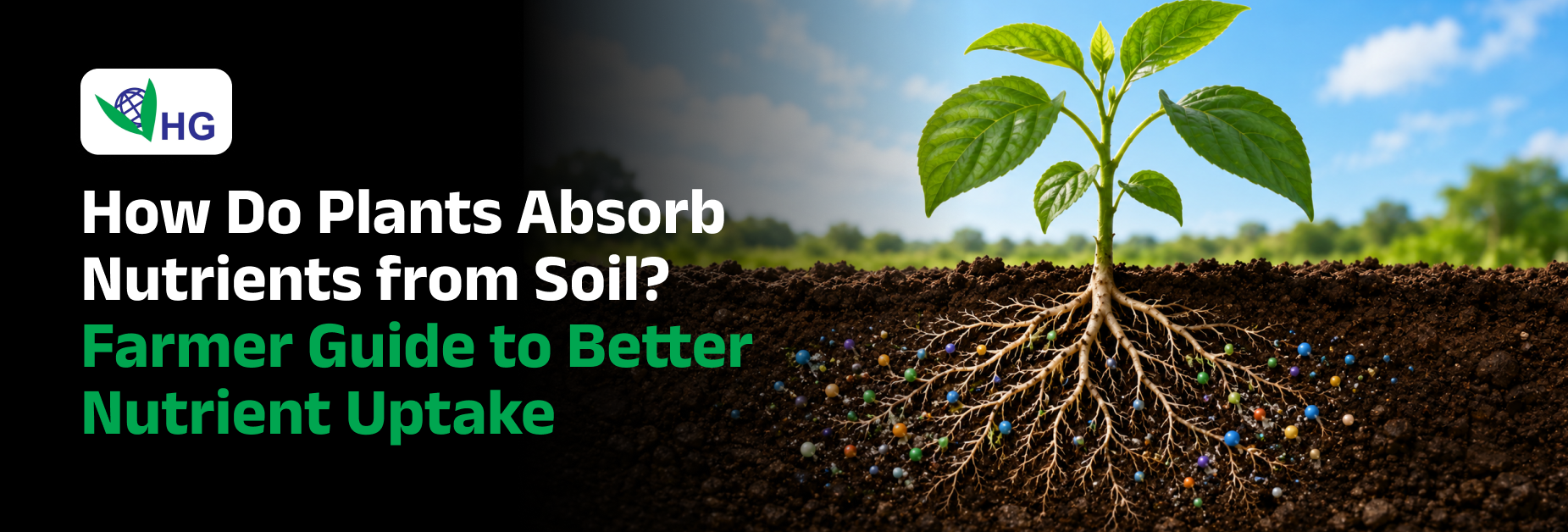

How Do Plants Absorb Nutrients from Soil? Farmer Guide to Better Nutrient Uptake
Introduction
Why do some fields produce a lot with just a little fertilizer, while others need much more and still underperform? The difference comes down to how well plants take in nutrients.
Many people assume soil nutrients are always available. In reality, they can be locked in unusable forms, trapped in dry or compacted soil, or otherwise out of reach — leaving crops effectively starving.
To get the most from your crops, you need to understand how plants absorb nutrients — how roots work, how much moisture is in the soil, and how active the microbes are. By mastering these factors, farmers can get more from every input and grow better crops from the very first season.
The Science of Plant Nutrition: How Root Systems Work
We need to understand what's happening underground before we can fix anything. Roots are far more than pipes and anchors for support and water uptake — they're remarkably complex.
The Role of Root Hairs and Surface Area
Most of the nutrients a plant absorbs don't come from large roots — they come from tiny root hairs, single-cell extensions on young roots. A single rye plant can have billions of them, each just 0.1 to 1 mm long, creating an enormous surface area for absorption.
This large surface area brings soil particles, water films, and microbes into close contact, helping the plant take in more nutrients. Root hairs thread through tiny pore spaces to reach dissolved nutrients directly. That's why healthy soil structure matters so much: compacted soil restricts root-hair growth, reducing surface contact and nutrient absorption — even when the soil is rich in nutrients.
Active Transport vs. Passive Transport
Plants take in minerals two main ways: passive transport and active transport.
Passive transport uses osmosis and diffusion to move water and dissolved nutrients from higher concentration in the soil to lower concentration inside the root, requiring no energy. It mainly handles water-soluble nutrients such as certain forms of nitrogen.
Active transport uses energy (ATP) and specialized membrane proteins to move nutrients against their concentration gradient — essential for taking up minerals like calcium, potassium, and phosphate. Crucially, it requires oxygen, because roots need oxygen to produce ATP. When soil is waterlogged or compacted, roots can't breathe, and nutrient uptake slows or stops — even when nutrients are abundant.
Essential Macronutrients vs. Micronutrients
Plants need large amounts of macronutrients — nitrogen, phosphorus, potassium, calcium, magnesium, and sulfur — and small amounts of micronutrients such as zinc, iron, manganese, boron, copper, and molybdenum. Each nutrient has a specific role, from driving growth to moving energy to activating enzymes. A shortage of even one can lower overall crop yield, even when every other nutrient is present.
4 Critical Factors Affecting Nutrient Absorption in Soil
Now let's look at the environmental and management factors that determine whether complex roots actually produce productive crops — the things you can control.
1. Soil pH and Nutrient Bioavailability
Soil pH is the master control of plant nutrition, governing which nutrients roots can access. Most crops perform best between pH 6.0 and 7.0, where nutrients are most available. Below 5.5, phosphorus becomes insoluble, molybdenum drops, and aluminum and manganese can reach toxic levels. Above 7.5, key micronutrients like iron, zinc, boron, and copper become unavailable. Test your soil regularly — at least once every two years — and adjust pH gradually with lime (to raise it) or sulfur/acidifying fertilizers (to lower it). Fixing it early is far easier than later.
2. Soil Moisture and Water Retention
To reach roots, nutrients must dissolve in water and travel through the thin moisture films around soil particles. When soil dries below a certain point, these films shrink and nutrients can't move — causing deficiency even when nutrients are present. Too much water, on the other hand, forces out air, suffocates roots, and leaches away mobile nutrients like nitrogen and potassium. The best uptake happens at field capacity, where the soil holds water while still allowing air into pore spaces. Maintaining this balance — especially during heavy rain — is essential for good nutrient absorption.
3. Microbial Biology and Soil Health
Soil microbes make nutrients available; plant roots take them in. Mycorrhizal fungi can effectively extend roots up to 100 times farther to capture phosphorus and micronutrients in exchange for sugars — especially valuable in phosphorus-poor Indian soils. Nitrogen-fixing bacteria such as Rhizobium and Azospirillum convert atmospheric nitrogen into plant-usable forms, supplying 50–300 kg/ha per season naturally. But excessive fertilizer and chemicals can disrupt this system, reducing diversity and weakening the biological support that makes nutrients more effective.
4. Soil Aeration and Compaction
Active transport — how roots take up phosphorus, potassium, and micronutrients — is often underrated. In compacted soils, oxygen levels can drop to nearly zero after rain or irrigation, turning roots anaerobic and halting ATP production and nutrient uptake. These conditions also encourage harmful microbes, root diseases, and toxic gases. Compaction builds slowly from repeated machinery use or a fixed tillage depth — by the time yields visibly fall, the soil is already badly damaged.
Actionable Strategies for Farmers to Improve Nutrient Uptake
Identifying the barriers is only the first step. Next comes applying practical, field-level strategies that improve nutrient absorption throughout the year.
Optimizing Irrigation and Moisture Control
The goal of irrigation management is to keep root-zone moisture close to field capacity — neither too wet nor too dry. Drip irrigation achieves this by delivering water slowly and directly to the roots. The challenge in rainfed systems is the dry spells between rains. Plant-based, biodegradable soil absorbents solve this by holding large amounts of water in the root zone and releasing it slowly as the soil dries — keeping the soil moist and nutrient-rich through short dry spells and supporting steady crop growth.
Fostering a Healthy Soil Microbiome
Feed your soil's microbiome with organic matter such as compost, manure, and green crops to help nutrients cycle naturally. Favor biofertilizers like Rhizobium, Azospirillum, and mycorrhizae over broad-spectrum chemicals, especially at planting, to support root growth. Keep the soil covered with mulch or cover crops to protect microbes from UV exposure and temperature stress.
Targeted Fertilizer Application
In Indian agriculture, applying fertilizer routinely without knowing what the soil needs wastes a lot of money. Soil testing reveals which nutrients are deficient, which are already present, and what pH is needed to make them available. Apply nutrients in line with crop demand: nitrogen during tillering and stem elongation, phosphorus and potassium at the basal stage, and micronutrients early in vegetative growth. Split applications beat single doses — they keep nutrients available and cut leaching losses.
How Hindustan Gum Enhances Soil Health and Productivity
Understanding the science is great, but you need the right tools to profit from it.
Improving Soil Structure for Maximum Yield
Hindustan Gum makes plant-based hydrocolloids and guar-derived soil binders that strengthen soil. By forming stable aggregates, they improve pore space for water, air, and root growth — helping prevent crusting, limiting erosion, and supporting stronger root systems, so plants absorb nutrients and produce more.
Superior Moisture and Nutrient Retention
Applied at 5 kg per acre during sowing, Ankurayam — Hindustan Gum's biodegradable super absorbent — works directly in the root zone. It traps water and dissolved nutrients in a gel matrix, preventing them from leaching during rain or irrigation, then slowly releases moisture and nutrients during dry periods so roots always have enough throughout the crop cycle. The result: better nutrient uptake, improved germination and root development, reduced heat-stress losses, and more effective fertilizer use — getting more out of the same inputs.
Conclusion
Getting nutrients into plants isn't just about adding fertilizer — it depends on root health, soil moisture, and microbial activity. If any of these is weak, overall performance drops.
Before adding more fertilizer, check whether your soil can actually deliver the nutrients it already holds. Ensure the pH is right, moisture is adequate, biology is active, and air flows freely. Using solutions like Ankurayam to improve soil structure, control root-zone moisture, and support biological health helps every input work better and lifts yield.
Want to Maximize Your Fertilizer's Return?
Hindustan Gum makes plant-based soil-health and moisture-retention products built for Indian farming conditions — so you get more out of every input you use.
➜ Visit hindustangum.com or contact our agronomy team for a personalized soil health consultation.
Frequently Asked Questions (FAQs)
Q1. How do plants absorb nutrients from soil?
Root hairs enlarge the root surface area to help plants take in nutrients from the soil. Plants draw nutrients from soil water through passive osmosis or energy-driven active transport. For nutrients to be available, this process needs enough moisture, oxygen, and the right soil pH.
Q2. What helps plants absorb nutrients faster?
Plants absorb more nutrients when soil pH stays between 6.0 and 7.0, moisture stays near field capacity, the microbiome is active, and good aeration lets roots breathe. Moisture-holding additives like Ankurayam help keep nutrients dissolved and accessible at the root zone.
Q3. Why are nutrients present in soil but unavailable to plants?
Nutrients can become unavailable when soil pH is off, moisture is insufficient, or the soil is compacted. Very high or low pH makes nutrients hard to absorb, dry soil makes them hard for roots to reach, and compaction starves roots of oxygen. Low microbial activity also prevents nutrients from being converted into plant-usable forms.
Q4. How do roots take nutrients from soil without damaging themselves?
Roots are protected by layered, specialized cells. The epidermis (with its root hairs) handles absorption, while the endodermis has a waxy Casparian strip that admits beneficial ions and blocks harmful ones. This structure lets roots take in the nutrients they need while keeping cells healthy in challenging soils.
Q5. How can I improve nutrient uptake naturally without increasing fertilizer?
Start by testing the soil and correcting pH. Add compost, manure, and cover crops to support the microbiome, and use biofertilizers like mycorrhizae and nitrogen-fixing bacteria. Apply fertilizers in splits matched to crop growth stages, reduce tillage to improve structure, and use moisture-retaining products like Ankurayam to keep nutrients available in the root zone between rains.