 +91 1664-243891/92/94
 info@hindustangum.com


.png)
.png)
How to Improve Fertilizer Efficiency in Agriculture: 7 Proven Methods Farmers Should Know
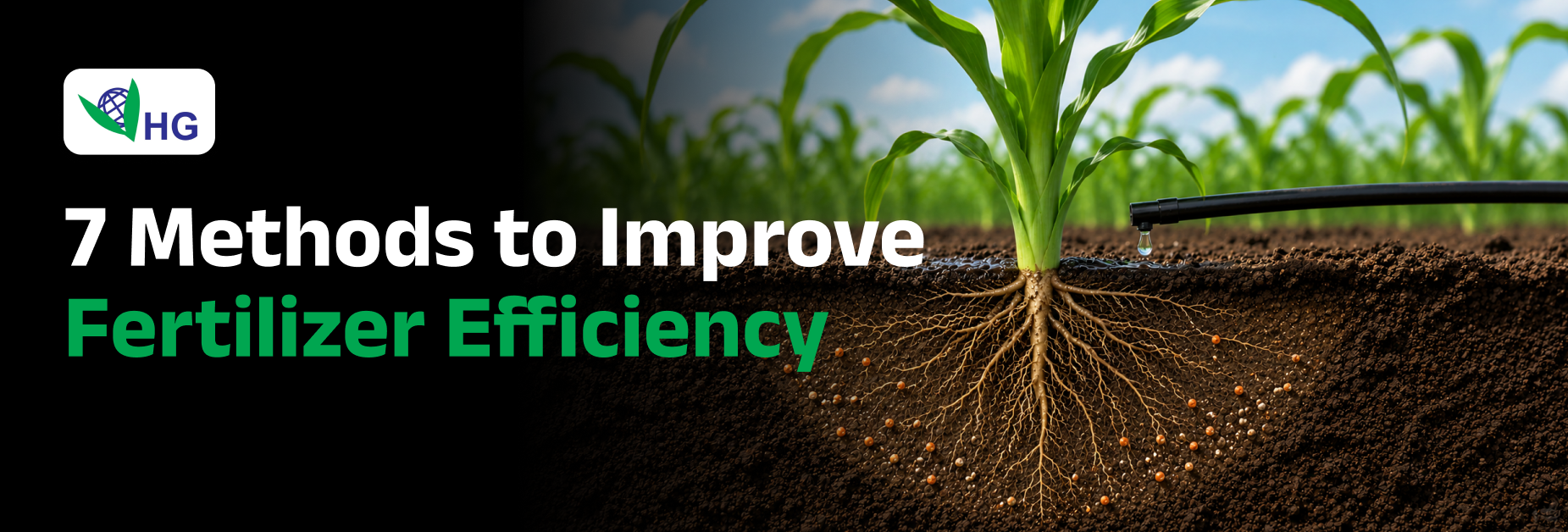

How to Improve Fertilizer Efficiency in Agriculture: 7 Proven Methods Farmers Should Know
Introduction: The Urgency of Nutrient Use Efficiency (NUE)
Why Fertilizer Efficiency is Critical in Modern Agriculture
Agriculture worldwide spends more than $200 billion a year on fertilizers, yet crops take in less than 50% of the nitrogen applied. The rest is lost through leaching, runoff, volatilization, and soil fixation — wasting money and degrading soil health over time.
Making farming more efficient requires a shift in thinking. Instead of adding more inputs, we should fix the ones that aren't working. Costs rise when fertilizers leak away before they're absorbed, while yields stay flat or fall — cutting into profits. Excess nutrients also harm the environment by polluting water, triggering algae blooms, and releasing greenhouse gases. Doing nothing is a lose-lose situation.
Understanding Fertilizer Use Efficiency (FUE)
Fertilizer Use Efficiency (FUE) measures how well nutrients convert into crop yield — the higher the FUE, the less waste. Rainfed farmers often apply common fertilizers like Urea and Di-Ammonium Phosphate in a single heavy dose, which drives nutrient loss. Fixing this is the first step toward better crop nutrient uptake.
Method 1: Utilize Biodegradable Super Absorbents (The Ankurayam Solution)
A highly innovative and practical farming input, especially valuable in low-rainfall areas.
The Challenge: Nutrient Leaching and Moisture Stress
Nitrogen (N) and potassium (K) dissolve readily in water. That helps plants absorb them, but it also means heavy rain can wash them out of the root zone — a process called leaching — making nutrients far less effective in open-field crops. Conversely, insufficient moisture during dry spells causes poor germination and weak root growth, leading to uneven stands and lower yields. In short, too much water makes nutrients less available, and too little makes uptake harder — both hurt crops.
Introducing Ankurayam: A Biodegradable Super Absorbent
Hindustan Gum developed Ankurayam, a biodegradable, safe-to-use super-absorbent granule made from natural guar-based polymers. Applied to the root zone, it soaks up large amounts of water and dissolved nutrients, easing soil moisture stress and reducing fertilizer loss. It forms a gel-like reservoir that slowly releases water and nutrients during dry periods and prevents nutrients from leaching during heavy rain — essentially a smart sponge for the soil.
Key Agronomic Benefits of Using Ankurayam
The benefits of Ankurayam extend well beyond moisture retention:
- Increased Fertilizer Use Efficiency: It holds mobile nutrients like nitrogen and potassium in the root zone, slowing their loss and keeping urea available longer after rain — improving nutrient availability and overall FUE.
- Improved Soil Health: By retaining moisture and nutrients, it supports better aeration and a more active root environment, helping the soil function as a living system.
- Yield Boost Through Continuous Moisture: Keeping the germination zone moist helps seeds sprout faster and more evenly. Wheat, rice, and legumes grow better with steady moisture during the vegetative stage, and plants tolerate heat stress better. Farmers report denser, higher-yielding crops — especially in rain-dependent kharif crops.
Ankurayam is a low-cost, high-impact solution for better fertilizer management. Applied at just 5 kg per acre during planting, it is effective and fully biodegradable, leaving no residue in the soil.
Method 2: Implement Comprehensive Soil Testing & Analysis
You wouldn't take medicine without knowing what's wrong — yet many farmers apply the same fertilizer every year regardless of what their soil actually needs.
The Solution to Blind Application
The most important first step in fertilizer management is soil testing, which reveals pH, organic matter, CEC, and nutrient levels. CEC (cation exchange capacity) determines how well soil holds nutrients: clay- or humus-rich soils have high CEC and retain nutrients well, while low-CEC sandy soils need smaller, more frequent applications because they lose nutrients easily. Soil pH also governs phosphorus availability — below 6 or above 7.5, phosphorus becomes locked up. Adjusting pH with lime or sulfur can make nutrients more available without adding more fertilizer.
Modern Soil Testing Technologies
Modern soil management goes beyond slow lab tests. GPS-guided sampling and real-time sensors reveal how nutrients vary across a field, enabling more precise application that reduces waste and keeps nutrients where they're needed most.
Method 3: Adopt the 4R Nutrient Stewardship Framework
The globally recognized 4R framework keeps fertilization balanced: use the Right Source at the Right Rate, Right Time, and Right Place.
Right Source & Right Rate
Granular urea, liquid ammonium sulfate, and slow-release nitrogen all behave differently in soil, so the right form must match the crop type, growth stage, and soil condition. The Right Rate means determining nutrient needs from realistic yield targets and applying only what's necessary. Overuse raises soil salinity (especially in irrigated crops), wastes money, and reduces microbial activity.
Right Time & Right Place
Splitting fertilizer into two or three doses timed to peak crop demand gives better uptake than a single heavy dose — for example, applying nitrogen to rice at the basal, tillering, and panicle-initiation stages. Placing fertilizer close to the roots (banding) or using deep placement (such as urea briquettes in paddies) further reduces losses and improves nitrogen use.
Method 4: Leverage Precision Agriculture Technologies (Smart Farming)
If managing fertilizer is an art, precision agriculture lets you apply it exactly where it's needed instead of in broad strokes.
Variable Rate Technology (VRT)
VRT uses GPS maps and soil data to vary fertilizer rates across a field in real time — applying more in high-yield zones and less where retention is low. This improves efficiency, lowers costs, and reduces nutrient leaching. Shared-equipment programs are making it accessible to more mid-sized farms.
Drones and Satellite Imagery
NDVI (Normalized Difference Vegetation Index) imagery from drones or satellites produces a color-coded map of crop health across the field, revealing stress zones before they're visible to the eye. Agronomists can then apply targeted foliar treatments or amendments, preventing yield losses that would otherwise only surface at harvest.
Method 5: Use Enhanced Efficiency Fertilizers (EEFs)
EEFs release nutrients in sync with crop demand, ensuring availability when needed and reducing loss when it's not.
Controlled-Release and Slow-Release Fertilizers
Polymer-coated urea (PCU) releases nitrogen slowly over 30–180 days depending on soil conditions, while sulfur-coated urea (SCU) is an affordable source of both nitrogen and sulfur. Their controlled release matches plant uptake, making them more effective than fast-release fertilizers.
Nitrification and Urease Inhibitors
Urease inhibitors such as NBPT temporarily block the urease enzyme, reducing ammonia loss to the air — particularly for surface-applied urea in hot, humid conditions. Nitrification inhibitors slow the conversion of ammonium to nitrate, limiting nitrogen leaching. Both are inexpensive ways to manage fertilizer better.
Method 6: Optimize Application Methods (Fertigation & Foliar)
How you apply fertilizer matters as much as which one you choose and when.
Fertigation: Synergizing Water and Nutrients
Fertigation mixes fertilizers with irrigation water and delivers them directly to the root zone via drip or sprinkler systems. By reducing evaporation losses and targeting the active root area, it can use 90%+ of applied nitrogen — compared with just 40–50% in traditional methods — especially when paired with soil moisture sensors.
Foliar Spraying for Rapid Correction
Foliar spraying quickly corrects micronutrient deficiencies (such as zinc, boron, or iron) when soil application isn't feasible, delivering nutrients directly through the leaves. For best results, spray in the early morning or late evening when stomata are open and humidity is higher, use chelated forms for better absorption, and avoid spraying during water stress or high temperatures, which reduce uptake.
Method 7: Integrate Organic Matter and Biological Practices
No fertilizer plan is complete without considering soil biology — the living ecosystem that converts nutrients into plant-available forms.
Building Soil Structure and Biology
Nutrient-poor soil behaves more like "dead dirt" than a living ecosystem. Adding compost, well-decomposed manure, and cover crops gradually restores biological activity — improving water retention, microbial life, structure, and nutrient-holding capacity (CEC). Ankurayam complements organic matter here: organic inputs build long-term soil health, while Ankurayam provides immediate moisture and nutrient retention, especially in the critical first 30–60 days after sowing. Together they improve root aeration, speed plant growth, and raise FUE from the start.
The Rise of Biofertilizers
Biofertilizers are microbial inputs that boost nutrient availability through biological processes. Rhizobium and Azospirillum fix atmospheric nitrogen in the root zone, while mycorrhizal fungi extend roots to improve phosphorus uptake. Combined with EEFs and organic amendments, they form a complete nutrient system that outperforms any single-input approach.
Conclusion: Securing Farm Profitability and Sustainability
Improving fertilizer performance isn't about spending more — it's about spending smarter. A layered strategy gets the most out of every rupee:
- Biodegradable super absorbents hold nutrients and water in the root zone.
- Soil testing ensures accurate nutrient decisions.
- 4R stewardship applies the right source, rate, time, and place.
- Precision agriculture makes applications more accurate.
- Enhanced efficiency fertilizers release nutrients in sync with crop uptake.
- Fertigation and foliar feeding deliver nutrients efficiently.
- Organic matter builds long-term soil health.
A good place to start is applying 5 kg/acre of Ankurayam at planting time. It costs very little while improving nutrient uptake, germination, and overall performance. Paired with soil testing and split applications, it far outperforms traditional farming methods.
Ready to Stop Losing Fertilizer to Leaching?
Hindustan Gum's Ankurayam is a safe, biodegradable root-zone absorbent that protects nutrients, aids germination, and increases yield right away.
➜ Go to hindustangum.com to find out more or place an order.
Frequently Asked Questions (FAQs)
Q1. What is fertilizer efficiency in agriculture, and why does it matter?
Fertilizer efficiency measures how well crops take up the nutrients applied versus how much is lost. Low efficiency wastes money, lowers yields, and harms the environment — so improving it is essential for both profit and sustainability.
Q2. How does fertilizer leaching in soil happen, and how can I prevent it?
When rain or irrigation is excessive, water-soluble nutrients like nitrogen and potassium wash out of the root zone — this is leaching. You can reduce it with split applications, nitrification inhibitors, controlled-release fertilizers, and biodegradable super absorbents like Ankurayam that keep nutrients in the root zone.
Q3. What is the best way to improve nitrogen use efficiency in crops?
Combine methods: apply urea in split doses matched to growth stages, add urease or nitrification inhibitors, prefer deep placement or banding, use fertigation where possible, and add a root-zone moisture retainer like Ankurayam to cut leaching losses.
Q4. How does Ankurayam by Hindustan Gum improve fertilizer efficiency?
Ankurayam is a biodegradable super-absorbent granule that gels in the root zone to hold water and nutrients. It prevents leaching during heavy rain and slowly releases moisture when it's dry — improving nutrient availability, germination, and overall fertilizer performance.
Q5. Can I use biofertilizers and chemical fertilizers together?
Yes — and it's recommended. Biofertilizers like Rhizobium, Azospirillum, and mycorrhizal fungi improve nutrient uptake by fixing nitrogen and aiding phosphorus absorption. Used alongside chemical fertilizers, they can cut chemical use by 20–30% while maintaining or even increasing yields — good for both the environment and your bottom line.